The Secret of the Empty Vessel: Space as the Source of All Potential
In our modern era, we are obsessed with the architecture of “more.” We measure our success by the fullness of our calendars, the density of our resumes, and the sheer volume of information we can consume before the sun sets. We treat our minds like hard drives—if there is a gigabyte of space left, we feel an urgent, almost neurotic need to fill it with a new podcast, a new goal, or a new anxiety.
But at Supeem, we believe this obsession with fullness is precisely why so many of us feel “stuck.” We are like a library so packed with books that there is no room for a reader to sit down and actually think.
The paradox of power is this: The value of a vessel is not in its clay walls, but in the emptiness within. Without the void, there is no room for the new. Without the silence, there is no room for the truth.
The Narrative: The Master, The Scholar, and the Overflow
Across the tapestry of Eastern philosophy, there is a recurring story that serves as the cornerstone of “unlearning.” It involves a brilliant scholar—a man of high status and immense knowledge—who traveled across treacherous mountains to seek the wisdom of a renowned recluse.
Upon arriving, the scholar did not listen. Instead, he talked. He spoke of his theories, his published works, and his vast understanding of the universe. He was, quite literally, full of himself. The Master listened in silence and began to pour tea into the scholar’s cup.
He filled the cup to the brim. And then, he kept pouring.
The scholar watched in horror as the hot tea spilled over the rim, flooded the saucer, and soaked into his expensive robes. “Stop!” he finally cried. “The cup is full! No more will go in!”
The Master set the teapot down and looked the scholar in the eye. “Like this cup,” he said calmly, “you are full of your own opinions and speculations. How can I show you wisdom unless you first empty your cup?”
This isn’t just a lesson in humility. It is a lesson in The Physics of Potential. If there is no vacuum, there can be no flow.
The Psychological Bridge: Receptivity vs. Clutter
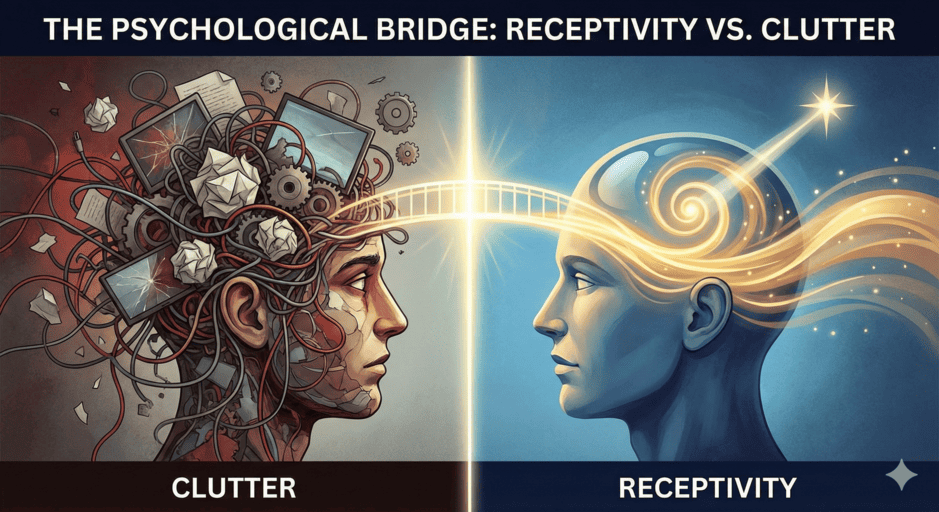
In contemporary psychology, we refer to this “fullness” as Cognitive Load. When our subconscious is saturated with the “noise” of past regrets, current to-dos, and future fears, we experience a state of internal resistance. We want to manifest change—we want to pursue our truest desires—but there is simply no “landing strip” available for those new energies to arrive.
To be an Empty Vessel is not to be hollow or ignorant. Rather, it is to cultivate a state of Active Receptivity.
When you “unlearn,” you are not deleting your history; you are simply refusing to let it occupy the front row of your consciousness. You are creating a “Void.” In physics, a void is never truly empty—it is a field of quantum potential waiting for a spark to initiate creation. When you create space in your mind, you allow your Intuition to speak. You allow your Desire to move from a vague wish to a focused force of nature.
The Visual Anchor: Why We Design for the Void
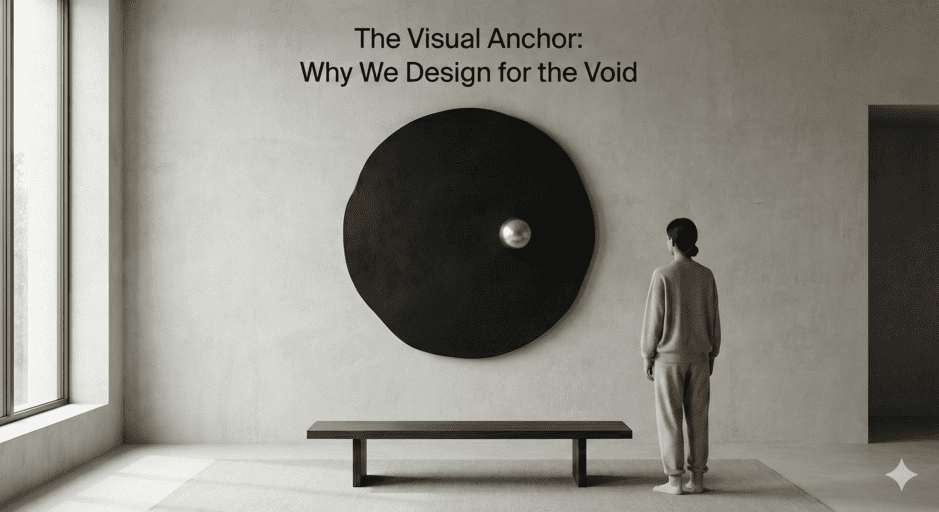
At Supeem, our artwork in “The Void” collection is an intentional rebellion against the cluttered world. We don’t just sell art; we sell Visual Reminders of Potential.
When you look at a Supeem piece that features an incomplete circle or a vast expanse of negative space, your brain undergoes a subtle shift. Because humans are wired for “closure,” your mind initially wants to fill that gap. But as you observe the art, you begin to accept the gap. You begin to see the beauty in the nothingness.
- Negative Space: This acts as a lung for your room. It allows the energy of the space to breathe.
- Minimalist Geometry: Simple forms don’t demand your attention; they invite it. They serve as a “Quiet Point” in a loud world.
By placing these Visual Anchors in your home or workspace, you are signaling to your subconscious every day: “It is safe to let go. It is necessary to be empty. I am ready for the new.”
The Practice: The 30-Second Reset of the Vessel
You do not need an hour of meditation to experience the power of the empty vessel. You only need thirty seconds and a point of focus.
- The Stop: Put down your phone. Turn away from your screen. Look at a blank wall or a piece of minimalist art.
- The Pour: Inhale for four seconds. As you exhale for six seconds, visualize yourself pouring out a dark, cloudy liquid from your mind—this is the “tea” of your stress, your ego, and your assumptions.
- The Wait: Hold the empty breath for just two seconds. In that tiny gap, feel the “nothingness.” Notice that you are still here, even without your thoughts.
- The Return: As you breathe back in, imagine your vessel is now filled with clear, crystalline light—the light of pure potential.
FAQ: Navigating the Void
Q: Doesn’t “emptiness” lead to lack of motivation? A: Quite the opposite. Burnout comes from a vessel that is too full and stagnant. True motivation is a “pull” toward a desire. By emptying the vessel, you create the vacuum that pulls your goals toward you with less effort.
Q: How do I know if my “cup” is too full? A: If you find yourself unable to listen to others, if you feel constantly “busy” but unproductive, or if you feel a sense of mental “fog,” your cup is overflowing. It’s time to pour.
Q: Can art really change my mental state? A: Yes. This is the science of Neuro-aesthetics. Your subconscious processes visual symbols 60,000 times faster than text. A visual anchor like a minimalist print bypasses your logic and speaks directly to your nervous system, triggering a relaxation response.
“The usefulness of a door is in its opening. The usefulness of a window is in its transparency. To find the power of the thing, you must look at the space it provides.”